
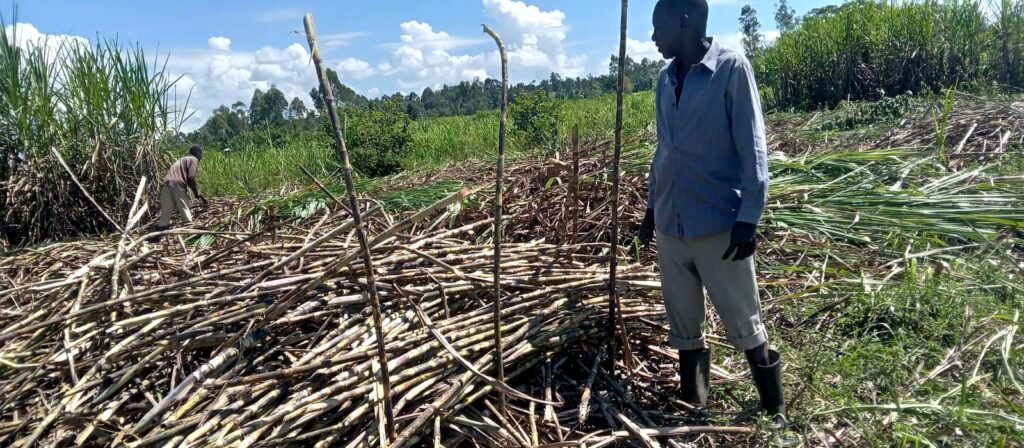
On a cleared patch at Nguku Site, Charles Aroko works down a row of freshly cut cane, laying each stalk into line — base to base, top to top — until a loose scatter of harvest becomes a clean, tight stack. It is slow, unglamorous work, and Charles does it the same careful way every time, whether anyone is watching or not.
Most people never think about what happens to cane between the cut and the crush. Charles does. He knows that cane left scattered on bare ground bakes in the sun, draws moisture and picks up soil, quietly losing the sweetness the farmer grew it for. Every hour it lies loose is sucrose slipping away and trash building up — losses that show up later, at the mill, in figures a farmer never sees but always feels.
So he stacks. Off the ground where he can, aligned and compact, ready to load fast when the transport arrives. The tidiness is not for show; it is protection — of the farmer’s tonnage, of the cane’s quality, and of the time between field and factory that decides how much of the harvest survives the journey.
It is a standard Sukari’s field teams have been reinforcing across the zones — checking in on sites, holding to agreed harvesting practice, and marking out the contractors who go past the minimum. Charles is one of them. His stack at Nguku is the kind of quiet, repeatable discipline that, multiplied across hundreds of hectares and many cutting cycles, adds up to real cane saved.
The farmers whose cane he handles may never meet him. But the sweetness that reaches the mill in good condition — and the fair weight that comes back to them — passes through hands like his first. At Nguku Site, Charles Aroko is setting a standard the rest of the belt would do well to copy.