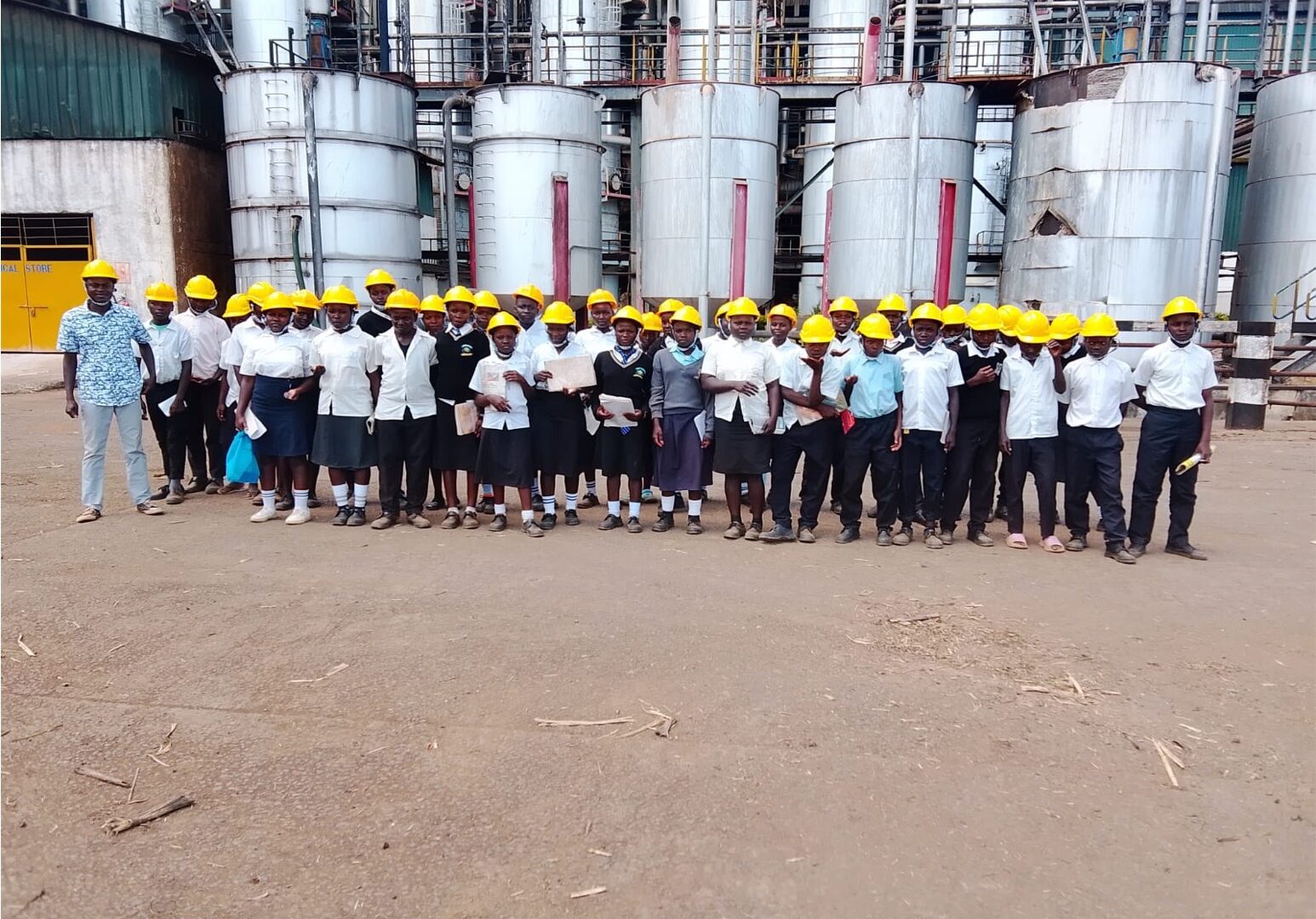
At a glance: Over 140 learners from Grades 8 and 9 walked through Sukari Industries’ facilities on 20th February 2026. What they discovered changed how they view agriculture — and their own futures.
The students who arrived at Sukari Industries Limited on 20th February came from a predominantly agricultural community. Most came from families directly connected to the sugar sector. Sugarcane farming surrounded their daily lives.
Yet for all this proximity, their understanding of the production value chain remained largely theoretical.
“We teach Agriculture, Science, Business Studies, and Environmental Studies in school,” explained lead teacher Pauline Aseto. “But textbooks and classrooms cannot fully convey what happens inside a factory. Learners knew cane becomes sugar. They did not know how.”
This gap between classroom instruction and real-world industrial application limited students’ ability to connect academic learning to career pathways. It made it difficult to appreciate the full scope of opportunities within their own local sector — opportunities that could become their futures.
Opening the Factory Gates
Sukari Industries opened its facilities to more than 140 Grade 8 and 9 learners, accompanied by three teachers. The structured educational tour took students through the entire sugar production process — from cane reception and weighing, through crushing and processing, to quality control, packaging, and storage.
Company staff from engineering, laboratory services, logistics, and administration patiently explained each stage. They highlighted safety standards, environmental management, and the teamwork required for efficient operations. The tour was deliberately interactive, encouraging students to ask questions and engage with professionals.
Immediate Impact
The tour’s impact was immediate and multi-dimensional. Grade 9 learner Britine Owigo reported that observing production stages firsthand deepened her understanding of Agriculture and Science lessons — and inspired consideration of agribusiness as a career path.
“I did not know so many different jobs exist in sugar production,” she said. “Engineers, laboratory technicians, logistics coordinators, quality controllers. These are careers I can prepare for. These are jobs in my community.”
Grade 8 student Brian Otieno described the experience as eye-opening, noting the impressive scale and coordination of operations. “Everything must work together — the machines, the people, the timing. If one part stops, the whole process stops. It is like a team, but bigger.”
Lead teacher Pauline Aseto emphasised that such exposure strengthens competency-based learning in ways the classroom alone cannot replicate. “When learners see, touch, and ask questions in real environments, understanding deepens. They do not just know facts. They understand processes. They grasp why things matter.”
Beyond Academic Gains
The tour’s benefits extended beyond academic reinforcement. Students experienced a professional industrial environment, complete with safety protocols and workplace expectations. They interacted with professionals who started where they are now. They saw, perhaps for the first time, that the sugar industry offers diverse, dignified career paths.
The tour also reinforced the school-industry partnership, demonstrating Sukari Industries’ active commitment to education, youth empowerment, and community development. Students left not only with deeper understanding but with positive associations — a factory that welcomed them, professionals who answered their questions, an industry that values learning.
Seeds Planted
For the 140 learners who walked through Sukari Industries that February morning, the experience planted seeds that may take years to fully germinate. Some will pursue agricultural careers. Some will become engineers, laboratory technicians, or logistics coordinators. Some will farm. Some will teach.
All will remember the day they saw their community’s central industry from the inside.