
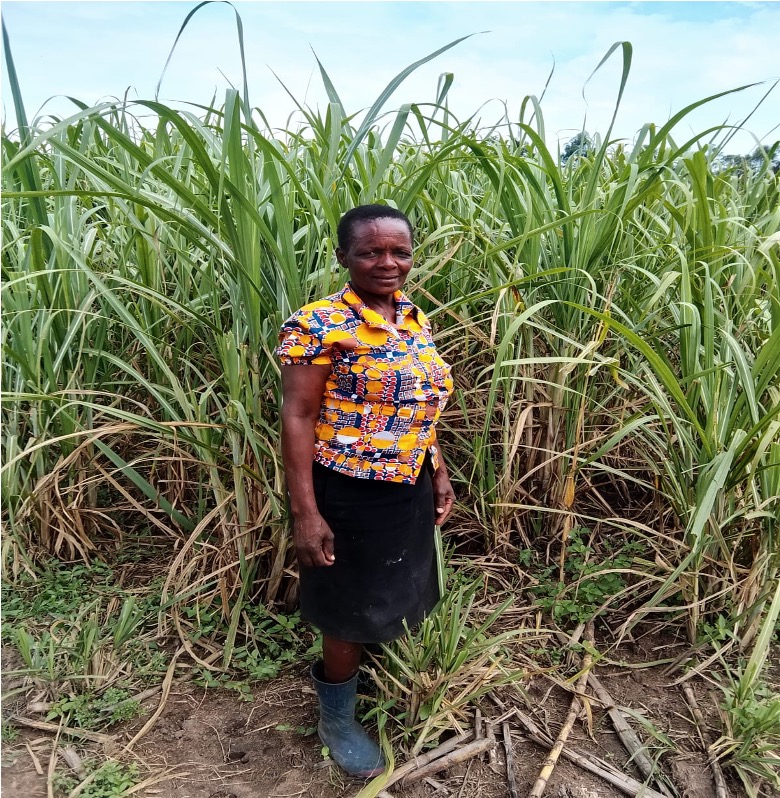
Jane Adhiambo Ajuma
At a glance: Widowed in 2015 with four children to support, Jane Adhiambo Ajuma faced the dual burden of grief and financial uncertainty. Ten years later, her 11-acre sugarcane farm provides the backbone of her household — and hope to women across Otange Village.
The year 2015 brought Jane Adhiambo Ajuma to a crossroads. Her husband had passed away suddenly, leaving her solely responsible for four children. Grief was compounded by acute financial insecurity. In rural Otange Village, formal employment opportunities were scarce. Widows, particularly those heading households, faced disproportionate vulnerability with few safety nets.
Jane had no steady income. School fees loomed. Daily needs pressed. The path ahead appeared narrow and uncertain.
“I could have given up,” she recalls quietly. “Many women in my situation do give up. Not because they lack strength, but because the obstacles seem impossible. When you are grieving and worrying about feeding children, the future becomes very small.”
Choosing Resilience
Jane made a choice that would define the next decade of her life: resilience over dependency. Looking around her community, she identified one asset within reach — land. And one opportunity within the local economy — sugarcane farming, supported by Sukari Industries.
“I knew farming. Every woman in this village knows farming. But knowing farming and treating it as a business are different things,” she explains. “I decided my farm would not just feed my children. It would educate them.”
Through disciplined management and consistent reinvestment of earnings, Jane established 11 acres under sugarcane cultivation. She prioritised proper agronomic practices — timely planting, weeding, fertiliser application. Her farm operates not as subsistence agriculture but as a professional enterprise.
Balancing large-scale farming with single motherhood required extraordinary effort. Jane also maintains casual employment at Otange Dispensary, serving her community while supplementing household income. The combination leaves little idle time.
“I wake early. I plan each day. I do not waste hours,” she says simply. “Children need attention, farms need attention, patients need attention. You learn to give each what it requires when it requires it.”
Transformation Visible and Lasting
The transformation in Jane’s household has been profound. Income from her sugarcane farm now provides the financial foundation for her family — covering food, clothing, basic needs, and most importantly, keeping all four children in school.
“My children are my legacy,” Jane states. “Everything I do, I do for them. When I pay school fees, I am not just paying for this term. I am investing in their future, in the families they will raise, in the cycle I am breaking.”
Beyond her household, Jane has become a beacon of hope to widows and women across Otange Village and surrounding communities. Women who once viewed farming as merely survival now see it as a path to independence. Widows who assumed their circumstances were fixed now approach Jane for advice on registering with Sukari, accessing inputs, and managing cane professionally.
“When a widow sees me standing in my farm, paying school fees from my cane money, she begins to think differently,” Jane observes. “She thinks: if Jane can do this, perhaps I can too. That thought is powerful. It changes everything.”
Proof in Practice
Jane’s 11 acres stand as daily proof that strategic investment and hard work can rebuild livelihoods, even in the face of profound loss. Her story challenges assumptions about who can succeed in agriculture. It demonstrates that with courage, discipline, and proper support, farming can lift households from vulnerability to stability.
She credits Sukari Industries with providing the institutional backing that made her success possible — access to markets, agronomic advice, timely payments.
“The company does not discriminate. They support anyone who farms properly, whether man or woman, married or widowed,” she notes. “That consistency matters. It gives women confidence that our effort will be rewarded fairly.”
A Legacy Growing
Today, Jane Adhiambo Ajuma stands tall in her community — not despite her circumstances, but because of how she responded to them. Her farm flourishes. Her children attend school. Her example inspires.
“When I look at my farm, I see more than cane,” she reflects. “I see the journey from 2015 to today. I see the tears I cried and the prayers I prayed. I see school fees paid and uniforms bought. I see my children’s future, growing row by row.”