
How one farmer in Kamasi Village, South Kabura, is redefining what a sugarcane farmer can look like in Ndhiwa, Homa Bay County.
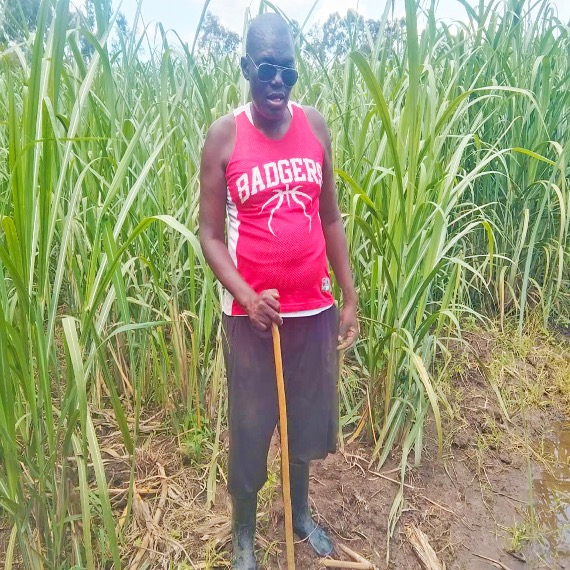
In Kamasi Village, South Kabura, the assumptions about what a person with visual impairment can achieve have long settled like dust — undisturbed, unquestioned, and largely unchallenged. Samson Ochieng Orwe decided, quietly and without fanfare, to disturb them.
At 47 years old, raising five children, and navigating a rural economy where formal employment is scarce for everyone and even scarcer for people with disabilities, Samson faced an intersection of challenges that would have been enough to defeat lesser resolve. Stigma. Assumption. The logistical reality of supervising field operations, monitoring crop growth, and managing labourers with limited vision. Any one of these would have been grounds for surrender. Samson did not surrender. He farmed.
The land does not ask about your eyes. It asks about your effort.
— Samson Ochieng Orwe (Oliso), Sugarcane Farmer, Kamasi Village
Building a Farm, Building a Future
In 2023, Samson committed 3.5 acres to sugarcane cultivation. He did not approach the decision casually. He invested in proper land preparation, followed the agronomic guidelines of Sukari Industries field officers, ensured timely weeding and fertiliser application, and managed his crop as a structured business enterprise — with records, plans, and clear seasonal goals.
What makes this story remarkable is not the acreage. Three and a half acres is a beginning, not a destination. What makes it remarkable is the method — and the context. Every task a sighted farmer performs with straightforward observation, Samson performed through heightened awareness, systematic process, and a deep understanding of his land built over years of intentional engagement. He did not merely adapt to his disability. He built a farming system that accounted for it.
“No matter your situation,” he says, in the measured tone of a man who has tested this belief against real conditions, “there is always something you can do to improve your life.”
Income That Educates and Empowers
The returns from Samson’s farm are not theoretical. One of his five children is currently enrolled in college — a milestone that did not happen by accident, but by harvest. Two more are progressing through senior secondary school, their fees met season by season, ratoon by ratoon.
This is the compounding power of agricultural income that Samson speaks of when he sits with younger farmers: it arrives in meaningful amounts. It enables planning. Unlike the precarity of casual labour — payment that disappears between the palm and the pocket — cane income is tied to an asset, a process, and a long-term relationship with a buyer. It can be anticipated. It can be deployed.
“You can do things with cane money,” he explains. “Pay school fees. Reinvest in the next ratoon. Buy something that lasts. Casual work gives you today. Farming gives you seasons.”
Disability Is Not Inability
Samson’s most powerful contribution to his community may be the one he has never delivered from a podium. It is the contribution of his presence — of neighbours walking past his well-maintained fields and drawing their own conclusions. Of community members who carry assumptions about disability encountering evidence that those assumptions are wrong.
In contexts where people with disabilities are often positioned as recipients of community support rather than contributors to it, Samson is both. He receives the same agronomic backing available to all Sukari farmers. And he contributes — a productive farm, employed local labourers, children investing their education back into the community. The transaction runs both ways.
No matter your situation, there is always something you can do to improve your life.
— Samson Ochieng Orwe (Oliso), Sugarcane Farmer, South Kabura
A Symbol the Community Did Not Know It Needed
Samson Ochieng Orwe is, first and foremost, a farmer. He does not regard himself as a symbol or an advocate. He regards himself as a man with land, children to educate, and a crop to manage. But that refusal to frame his life as exceptional is precisely what makes it powerful.
His 3.5 acres are a foundation — for his family’s security, for his children’s futures, and for a quietly shifting community narrative that is beginning to recognise, acre by acre and harvest by harvest, that disability is one characteristic among many — not a ceiling on what a person can achieve or contribute.
Sukari Industries is proud to call Samson Orwe a partner in the sugar value chain. More than that — we are proud to learn from him.