
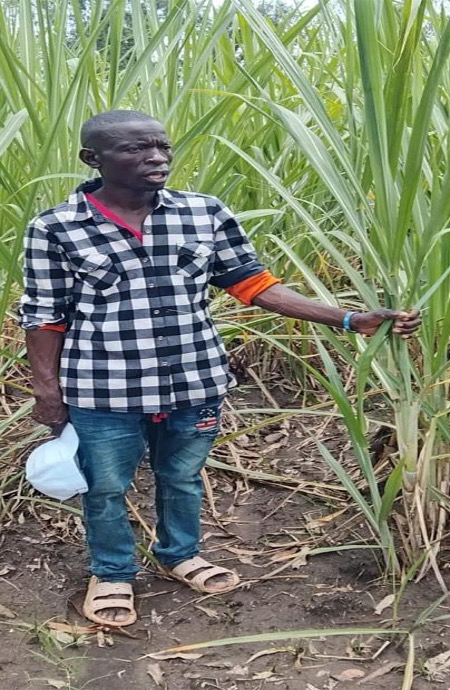
There are farmers who begin with advantages — inherited land, established networks, capital accumulated across generations. And then there are farmers like Frederick Ochieng Agembo, who begin with three-quarters of an acre and a conviction that careful work, compounded over time, is a strategy that never fails.
Frederick was 25 when he planted his first sugarcane on a modest plot in Ariri Village. In a community where smallholder farming is both a livelihood and a lifestyle, even that fraction of an acre represented a deliberate wager — not on luck, but on a principle he had observed among the more established growers around him: that sugarcane, properly managed, rewards those who stay the course.
I started with three-quarters of an acre. People thought it was too small to matter. I knew it was enough to start. The size of the beginning does not determine the size of the outcome.
— Frederick Ochieng Agembo, Sugarcane Farmer, Ariri Village
The Harvest That Changed Everything
When Frederick’s first harvest came in, it delivered KES 40,000. For a first-time farmer working a fraction of an acre, the figure was more than income — it was proof. Proof that the crop worked. Proof that his agronomic discipline — the timely inputs, the attentive field monitoring, the refusal to cut corners on weeding — had translated into real returns.
But what Frederick did with that KES 40,000 is the heart of his story. He did not treat it as a windfall. He treated it as capital.
“I sat down and I thought carefully,” he explains. “I could spend this money and be comfortable for a season. Or I could use it to grow the farm and be comfortable for life. That was not a difficult choice.”
He leased additional land. He expanded. He reinvested again. The pattern, once set, became a discipline — not a stroke of good fortune repeated, but a deliberate system applied season after season with the consistency of someone who understood that the compound effect of smart decisions is the most powerful financial tool available to a smallholder farmer.
Eleven Acres and a Life Rebuilt
Today, Frederick manages 11 acres under sugarcane cultivation. The journey from three-quarters of an acre to eleven represents a fourteen-fold expansion — and none of it arrived by chance. It arrived through a decade of decisions: when to reinvest, when to expand, when to hold firm and manage carefully rather than stretch beyond capacity.
The milestones his farm has funded are tangible and lasting. He has purchased a plot of land — a permanent asset that will outlast any single harvest. He is educating three children, investing in a generation that will carry his choices forward. And he is currently planning and constructing a permanent family home — a milestone he speaks of with the measured pride of a man who has earned every brick.
“When I look at what I have built, I see years of choices,” he reflects. “Every good decision I made is represented somewhere in what I have today. The land. The school fees. The house going up. None of it happened by accident.”
His Formula, Offered Freely
Frederick’s most consistent message — shared in community meetings, with neighbours, with any young person who will listen — challenges the widespread perception that farming is a last resort. He has built more through farming than most people he knows who chose different paths.
Patience: sugarcane is not a short-term crop. Its rewards come to those who commit to the full cycle — no shortcuts, no premature harvesting, no abandonment when results take time to arrive.
Discipline: inputs applied late, weeding neglected, ratoons mismanaged — every lapse translates directly into lost income. The crop reflects how it is managed, accurately and without mercy.
Proper planning: know your costs, your harvest dates, and how you will deploy each payment before it arrives. Planning transforms income into strategy.
Reinvestment: the first harvest is not the destination. It is the capital for the next stage of growth. Every shilling reinvested compounds. Every shilling spent is merely consumed.
Every shilling I reinvested brought me closer to where I am now. I did not arrive here overnight. I arrived here through ten years of choosing the farm over comfort.
— Frederick Ochieng Agembo
Proof in Practice
Frederick Ochieng Agembo’s journey from three-quarters of an acre to an eleven-acre commercial operation is not an outlier. It is a blueprint — built from patience, strategic reinvestment, and an unflinching belief that agriculture, practised with discipline, delivers genuine prosperity.
His story challenges the narrative that sugarcane farming is only for established, well-resourced growers. The barrier to entry is lower than many assume. The ceiling is higher than most imagine. And in Ariri Village, a young man who started with three-quarters of an acre now stands as one of the most compelling arguments for why farming — approached as a business — remains one of the most reliable paths to financial independence in rural Kenya.