
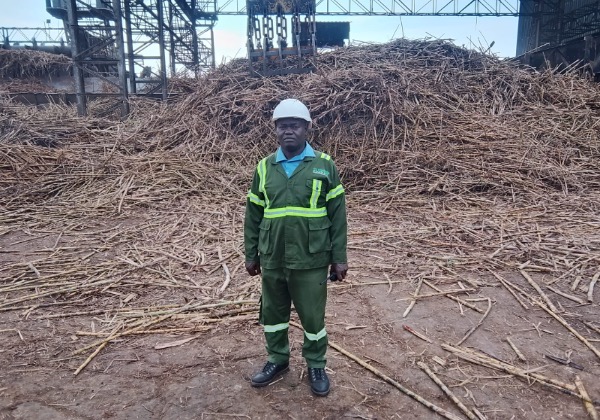
At a glance: For 11 years, Eng. Boaz Amoke has served as Chief Engineer at Sukari Industries Limited. But his most enduring contribution to the company’s ecosystem may be happening on 85 acres of farmland — where he proves that technical expertise and agriculture are natural partners.
When Eng. Boaz Amoke joined Sukari Industries Limited in June 2013, he brought more than engineering qualifications to the role. He brought a farmer’s understanding of soil, seasons, and patience—knowledge gained during 18 previous years at West Kenya Sugar Company, where he observed sugarcane from both industrial and agricultural perspectives.
That dual understanding would shape his approach to personal financial planning.
“Many professionals in our sector make a common mistake,” Amoke observes. “They rely entirely on salary. They assume employment will always be there, that monthly income will never stop. But the sugar industry has cycles, like farming itself. Those who plan only for stability during good times often struggle when conditions shift.”
Immediately upon joining Sukari, Amoke began investing in sugarcane farming. Not as a hobby. Not as a side project. But as a strategic parallel income stream, managed with the same precision he applies to factory operations.
Engineering Discipline Applied to Agriculture
Drawing on agronomic experience from his West Kenya years, Amoke approached farming systematically. Land preparation followed strict timelines. Weeding was never delayed. Fertiliser application was precisely calibrated. Herbicides were targeted. Every stage adhered to recommended guidelines.
“The mind of an engineer suits farming well,” he explains. “Farming requires planning, measurement, monitoring, and adjustment. These are engineering habits. When I look at a field, I see variables to manage—soil health, moisture levels, pest pressure, nutrient requirements. My training teaches me to control variables, not be controlled by them.”
Through consistent reinvestment and careful planning, Amoke expanded his farm to 50 acres under active cultivation, primarily through leased land. Each acre is managed professionally, with records maintained and performance tracked. The operation functions not as subsistence agriculture but as a structured agribusiness enterprise.
Today, his farms deliver reliable, sustainable returns that complement his professional income. The combination creates what he calls “financial resilience”—the ability to withstand economic fluctuations without distress.
A Quiet Influence on Colleagues
Amoke’s example has not gone unnoticed within Sukari Industries. Colleagues observe his dual success and increasingly approach him for advice. How do you balance factory responsibilities with farm management? How do you access quality inputs? Which varieties perform best under local conditions?
He mentors quietly, without fanfare, encouraging fellow professionals to view agribusiness as a pathway to financial independence. His advocacy has already influenced several colleagues to explore farming, creating a ripple effect throughout the organisation.
“When a colleague tells me they have started farming, even on one acre, I consider that a success,” Amoke says. “A 100-kilometre walk starts with a step somewhere. The important thing is to begin.”
Protecting What Matters
The decision to share Amoke’s story requires balance. His position as Chief Engineer makes him valuable to Sukari Industries—and potentially attractive to competitors. Yet his story also carries vital lessons about financial resilience, professional integrity, and the compatibility of technical expertise with agricultural enterprise.
What emerges is a portrait not of an individual vulnerable to poaching, but of a professional deeply rooted in an ecosystem. Amoke’s success is intertwined with Sukari Industries’ success. He has seen the factory grow from milling 800 tons per day to the current 3,500-plus tons. His farm benefits from the same agronomic support available to all Sukari farmers. His engineering work benefits from his agricultural insights. The relationship is mutually reinforcing, not easily replicated elsewhere.
“Working at Sukari has enabled my farming,” he acknowledges. “The knowledge I access here, the networks, the understanding of the value chain—these come from my role. In turn, my farming makes me a better engineer. I understand farmers’ challenges more deeply because I share them. I appreciate the production cycle from both ends.”
A Model for Financial Resilience
Amoke’s 50-acre farm now ranks among a select few that prove formal employment and strategic land investment can work hand in hand to secure long-term economic empowerment.
His story challenges the false choice between professional career and agricultural enterprise. At Sukari Industries, they are not mutually exclusive. They are complementary.
“Financial resilience is not about how much you earn,” Amoke reflects. “It is about how many income streams you have. It is about not depending on a single source. For professionals in the sugar sector, farming is the most natural second stream. We are surrounded by the industry. We understand the crop. The question is not whether we can farm. The question is whether we will.”